
Author: Liting Chen (陳俐婷) , Joseph Chan (詹燿州) | Bureau Veritas Taiwan
In the current technological landscape of 2026, the Civil Infrastructure Platform (CIP)—a collaborative open-source project hosted by the Linux Foundation—is celebrating its monumental 10th anniversary. Initially established in 2016 by global industry leaders, including Siemens, Toshiba, Hitachi, and Plat’Home, CIP set out with a bold vision: to build an open-source “base layer” of industrial-grade software capable of overcoming the strict longevity gap that exists between rapid Information Technology (IT) release cycles and decade-spanning Operational Technology (OT) lifecycles.
As an independent leader in the Testing, Inspection, and Certification (TIC) sector, Bureau Veritas is proud to contribute its perspective to this milestone celebration. In an era dominated by interconnected industrial networks, edge computing, and AI-driven automated control, maintaining a secure foundation for critical infrastructure requires moving far beyond simple code preservation.
As an engineer working on IEC 62443-4-2 certification, I (Liting Chen) am proud to take part in celebrating this important milestone. By establishing a highly dependable Open Source Base Layer (OSBL) anchored by Super Long Term Support (SLTS) kernels maintained for more than a decade, CIP has transitioned from a visionary open-source experiment into a certified, globally trusted digital public good.
The Paradigm Shift in OT Security: Why 10-Year Maintenance Requires Structural Trust
Securing industrial control systems presents an entirely different set of challenges compared to conventional corporate IT networks. In office automation, standard security practices accept short product lifecycles, rapid patching cadences, and brief system reboots. In contrast, civil infrastructure components operate under strict non-functional constraints where unscheduled downtime is entirely unacceptable, real-time performance is non-negotiable, and physical process failures can result in catastrophic environmental or health, safety, and environmental (HSE) impacts. A single bug or unpatched vulnerability inside a power grid controller or a high-speed interlocking railway control unit could directly jeopardize human lives.
This operational environment explains why the industrial sector is experiencing a massive paradigm shift. For years, asset owners relied on air-gapping as a defense strategy. However, the commercial necessity to pull diagnostic records, track supply chain efficiency, and process edge data has permanently connected OT environments to broader networks, expanding the direct attack surface.
Furthermore, the modern regulatory landscape has fundamentally altered market entry rules. In 2026, the European Union’s Cyber Resilience Act (CRA) enforces strict technical legal requirements on any commercial product embedded with digital elements. It mandates that products must be delivered with a “Secure by Default” baseline config and actively supported with vulnerability updates across their operational lifecycle.
Crucially, while the CRA recognizes the unique collaborative nature of open-source projects and exempts pure non-commercial upstream development from direct liability, that legal responsibility shifts immediately to commercial product suppliers who compile, brand, and sell these open-source building blocks inside finished commercial systems. Product manufacturers must therefore prove structural security.
A magnificent example of achieving this structural trust occurred precisely in time for this 10th anniversary: CIP successfully secured official third-party certification against the stringent technical criteria of the IEC 62443-4-2 standard at Security Level 2 (SL-2), utilizing Siemens Mobility’s robust M-COM communications hardware platform as its technical base layer. This milestone proves that open-source infrastructure components, when managed through rigorous compliance processes, can deliver certified industrial security
Integrating Threat Modeling and Security Hardening within the Secure SDLC (IEC 62443-4-1 Focus)
To sustain this exceptional certified baseline across a 10-year horizon, engineering teams must anchor their activities within a formal Security Development Lifecycle (SDLC) governed by the international IEC 62443-4-1 standard. In this context, practices such as threat modeling, security hardening, and testing become essential components of product development. The core philosophy of this framework is simple: security must be an active, process-driven architecture engineered into a product from its initial conceptual design phase, rather than a checklist appended to software right before release.
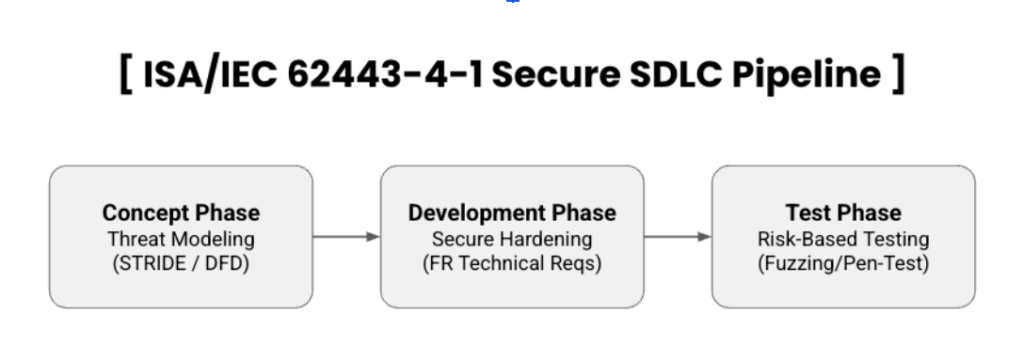
Within the ISA/IEC 62443-4-1 SDLC , Practice 2 of the standard mandates a continuous, specific process for constructing a formal Threat Model (Requirement SR-2). Within the CIP Security Working Group (SWG), threat modeling is tilized as a predictive diagnostic strategy to dissect how information flows across trust boundaries, independent of changing Linux or Debian code versions. From a security perspective, threat modeling plays a central role in meeting these expectations. Threat modeling helps answer fundamental questions: Who might attack? What are the critical assets? How could those assets be compromised? By addressing these questions early, organizations can design appropriate security architectures, such as protecting firmware update mechanisms or controlling access to sensitive interfaces.
By developing detailed Data Flow Diagrams (DFDs) representing common use cases—such as using a CIP image to drive an industrial Programmable Logic Controller (PLC)—engineers systematically apply the Microsoft STRIDE threat categorization matrix. This enables teams to identify specific threat profiles across all six dimensions:
- Spoofing: Verifying identity at trust boundaries to prevent unauthorized external entities from impersonating a trusted CIP Core maintainer or automated deployment repository.
- Tampering: Ensuring total integrity protection over compiled file-system layers against malicious binary injection during automated Debian mirror pulling.
- Repudiation: Enforcing granular audit logging and system tracking within build systems to register exactly who approved, signed, or modified metadata recipes.
- Information Disclosure: Preventing cryptographic data leaks by strictly evaluating default user permissions, transport encryptions, and configuration access settings.
- Denial of Service: Restricting external vectors that can cause processing routines or kernel loops to hang, thereby safeguarding essential safety instrumented system (SIS) functions.
- Elevation of Privilege: Evaluating local administrative contexts to ensure unauthenticated interface protocols cannot be exploited to impersonate the Root domain.
Source: CIP Threat Modeling Documentations
Once threat modeling establishes the precise threat landscape, the engineering team applies Security Hardening as a systematic tactical shield to minimize the active attack surface. Security hardening complements this by ensuring products are secure by default. As outlined in the official CIP Security Hardening documentation, this process transforms standard Linux templates into a hardened, defensive posture mapped directly to the technical requirements of IEC 62443-4-2:
| Hardening Discipline | Technical Action & Configuration Controls | IEC 62443 Component Requirement Reference |
| Credential & Access Control | Deactivate all default users and common passwords. Force exclusive password-less key-based SSH authentication. Protect critical keys via hardware roots of trust like Trusted Platform Modules (TPMs). | CR 1.1 (Access Control) / CR 1.9 (Public Key Authentication) |
| Attack Surface Reduction | Strip away all software packages, dependencies, and network programs non-essential to the system use case, e.g., disabling unnecessary services, eliminating debug interfaces, etc, completely eliminating on-board compiler build-tools. | CCSC 4 (Secure Software Development) / Minimal Baseline Principles |
| Data Flow Restrictions | Deploy kernel-level firewall technologies (such as nftables) locked to a strict “Deny by Default, Allow by Exception” configuration profile. | CR 5.1 (Network Segmentation) / NDR 5.2 RE 1 |
| System Integrity & Validation | Isolate static system file directories from dynamic changing write folders. Integrate advanced baseline scanners like AIDE for automated filesystem integrity checking. | CR 3.3 (Security Functionality Verification) / CR 3.14 |
Bridging Open Source Innovation with Compliance: The Role of Independent Assessment
In global industrial procurement, internal self-declarations of security compliance are no longer sufficient to build trust with asset owners or satisfy strict international trade authorities under the CRA framework. When an automated network component or a smart grid control unit enters a high-consequence facility, stakeholders demand verification from an objective, universally respected third party.
This verified assurance is exactly where an independent assessment conducted by Bureau Veritas bridges the gap between open-source speed and industrial safety requirements. When engineering teams leverage CIP’s hardened OSBL to construct custom infrastructure applications, our expert certification teams review the complete alignment of their development processes:
- Process Quality Verification: We thoroughly evaluate development logs, code review records, and static code analysis (SCA) metrics to verify that STRIDE threat modeling outputs have been mapped to actual design choices.
- Risk-Based Defensive Testing: Our specialized labs move beyond simple documentation audits to run rigorous binary vulnerability scanning, protocol fuzzing, and grey-box penetration testing, providing the definitive empirical data needed to demonstrate risk mitigation.
- Accredited Certification: Upon proving complete adherence to standard parameters, we issue a formal verification of conformity certificate, transforming regulatory compliance from a complex administrative burden into a distinct, strategic market advantage.
Conclusion: Empowering the Next Decade of Resilient Civil Infrastructure
Ten years of sustained operation have proven that the Civil Infrastructure Platform is not merely an engineering success; it represents a triumph of collaborative open-source philosophy applied to the most demanding environments on earth.
By taking responsibility for stabilization, CIP community adopting these practices also brings clear benefits. Addressing issues early in development reduces cost and helps protect a company’s reputation. It is widely recognized that fixing issues earlier in the lifecycle is significantly more efficient than addressing them after release. In this sense, security is not only a compliance requirement but also a strategic investment.
As industrial networks integrate edge compute capabilities and face an evolving threat landscape, proactive risk management remains essential. By embedding structured threat modeling and configuration hardening directly into the SDLC, component manufacturers can confidently navigate the demands of global security regulations. Bureau Veritas remains deeply committed to supporting this vital ecosystem, conducting independent assessments, and delivering accredited certificates that safeguard global critical infrastructure for the next decade and beyond.
English Meta Description: Celebrating the 10th anniversary of the Civil Infrastructure Platform (CIP) in 2026. Discover how Bureau Veritas evaluates the integration of STRIDE threat modeling and rigorous security hardening within the IEC 62443-4-1 secure product lifecycle, transforming open-source industrial Linux into a certified, CRA-compliant foundation for global societal lifelines.