THE LINUX FOUNDATION PROJECTS
Category

In the News

CIP Project releases a tool-box based on LAVA and KernelCI to test Linux kernels locally: Board At Desk v0.9.1

By In the News

The Civil Infrastructure Platform project, a Linux Foundation Initiative, is happy to announce the publication of Board At Desk – Single Dev. v0.9.1, a customised and easy to deploy instance of the kernelci.org and LAVA projects that should allow developers to test Linux kernels on boards connected to their own development machines using the tooling provided by one of the most successful Open Source and distributed testing projects.B@D v0.9.1
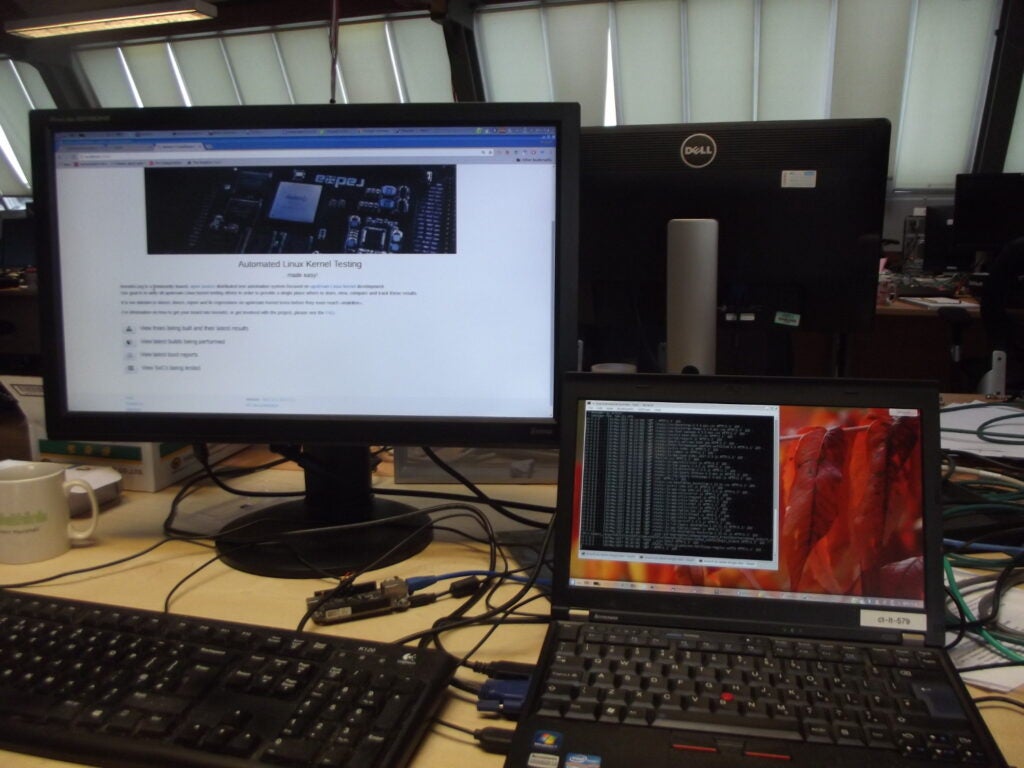
This instance is provided in this first release in two forms:

  • As a vagrant VM image/recipe.
  • As a VM image, widely called box.

Please visit the CIP Testing project Download page to download the first release of Board At Desk – Single Dev. (B@D v0.9.1).

With this effort, the CIP project is trying to create a first step towards “shared and trusted testing” by every member and the CIP kernel maintainer. It also has as a goal to extend and simplify the current use case satisfied by kernelci.org, focusing on those embedded developers that have direct access to boards, by reducing the deployment, configuration and maintenance costs. Finally, CIP intends to increase the number of developers and organizations willing to participate in kernelci.org by providing a simple mechanism to evaluate the technologies involved in what CIP consider B@D’s upstream project.

Some of the most important actions taken by the team behind B@D have been focused in two areas:

  1. Merged the KernelCI and LAVAv2 Virtual Machines together into one.

KernelCI was based on Ubuntu v14.04, it used Nginx as the Web Server and SimpleHTTPServer for the Storage Server which is where the builds are stored. LAVA was based on Debian and used the Apache Web Server and the Django Content Management System for the Frontend Web Framework. Both web servers wanted to use port 80.

The current VM uses Debian Jessie only. It runs KernelCI on Nginx and LAVA on Apache on reassigned ports. The KernelCI Storage Server has been migrated over to use Nginx on a reassigned port.

  1. Connection to the board.

The released VM assumes the usage of an FTDI USB-to-Serial cable to connect the host machine to the Beaglebone Black. It uses ser2net to route the /dev/ttyUSB0 serial port to a TCP port on the host machine which allows the user to use telnet to communicate to the Beaglebone Black console for remote login and boot messages. It also allows LAVA to use tftp to transfer the kernel directly over to the board eMMC without needing to burn an SD Card.

This B@D version supports Beaglebone Black. Renesas RZ/G1M support is in progress and the rest of the CIP reference boards will be supported in the near future.

Further information about what you will find in Board At Desk – Single dev. (B@D v0.9.1) can be found in the B@D Feature Page.

If you are interested in testing kernels using this version of the tooling please meet the developers at the cip-dev mailing list. If you find bugs in KernelCI or LAVAv2 themselves, please report them upstream. If you find them in the configuration or any of the previously described topics, please report them in the CIP-testing bug tracker. More general information about the CIP testing project can be found in the CIP Testing Landing Page.


[News Release] Renesas Electronics Extends Embedded Technology Leadership by Joining Civil Infrastructure Platform Project

By Announcement, In the News

Becomes first semiconductor supplier to join open source project working to create a base layer of industrial grade software

SAN FRANCISCO, February 15, 2017 – The Civil Infrastructure Platform (CIP) project today announced that Renesas Electronics Corporation has joined as a Platinum member. The CIP community is working to establish an open source base layer of software to enable the use and implementation of software building blocks that meet the safety and reliability requirements of industrial and civil infrastructure. Renesas joins founding Platinum members Hitachi, Siemens and Toshiba and Silver members Codethink and Plat’Home. CIP is hosted by The Linux Foundation, the nonprofit advancing professional open source management for mass collaboration.

CIP launched in the spring of 2016 to address the needs of organizations in industries such as power generation and distribution, water, oil and gas, transportation and building automation for reliable and secure Linux-based embedded systems that can be sustained over a period of 10 to as many as 60 years. By establishing this base layer, CIP aims to speed implementation of civil infrastructure systems, build upon existing open source foundations and expertise, establish de facto standards by providing a base layer reference implementation, and contribute to and influence upstream projects regarding industrial needs.

“As the first semiconductor supplier to join the Civil Infrastructure Platform project, we are pleased to extend our commitment to open technology development,” said Ichiro Tomioka, Vice President, Head of the ICT & Office Business Division at Renesas Electronics Corporation. “Contributing to the development of shared technology is critical to Renesas Electronics, in addition to our work with Yocto Project and Automotive Grade Linux. We are one of the most active contributors to Linux itself. We hope to work with the CIP community to further advance this important project.”

About the Civil Infrastructure Platform Project

The Civil Infrastructure Platform (CIP) is a collaborative, open source project hosted by The Linux Foundation. The project is focused on establishing an open source base layer of industrial grade software to enable the use and implementation of reusable software building blocks that meet the safety, reliability and other requirements of industrial and civil infrastructure. For additional information, visit https://www.cip-project.org/.

# # #

Critical Infrastructure Goes Open Source

By In the News

The electrical grid, water, roads and bridges—the infrastructure we take for granted—is seldom noticed until it’s unavailable. The burgeoning open source software movement is taking steps to help rebuild crumbling U.S. civil infrastructure while capitalizing on expansion in emerging markets by providing software building blocks to help develop interoperable and secure transportation, electric power, oil and gas as well as the healthcare infrastructure.

Under a program launched in April called the Civil Infrastructure Platform, the Linux Foundation said the initiative would provide “an open source base layer of industrial grade software to enable the use and implementation of software building blocks for civil infrastructure.”

Read More

Linux Foundation announces Civil Infrastructure Platform

By In the News

On the first day of the Embedded Linux Conference, the Linux Foundation announced a new software project called the Civil Infrastructure Platform (CIP).

CIP is an open source framework that will support the development of software needed to run critical services that create the backbone of any modern society, including electric power, oil and gas, water, health care, communications, and transportation.

Read More

Linux Foundation Launches Civil Infrastructure Project

By In the News

The Linux Foundation wants to help ensure critical services, such as electric power, oil and gas, water, healthcare, communications, and transportation, have the proper software foundation to deliver solutions. The organization has announced the Civil Infrastructure Platform (CIP), an open-source framework designed to ensure civil infrastructures provide safety, security and reliability.

Read More